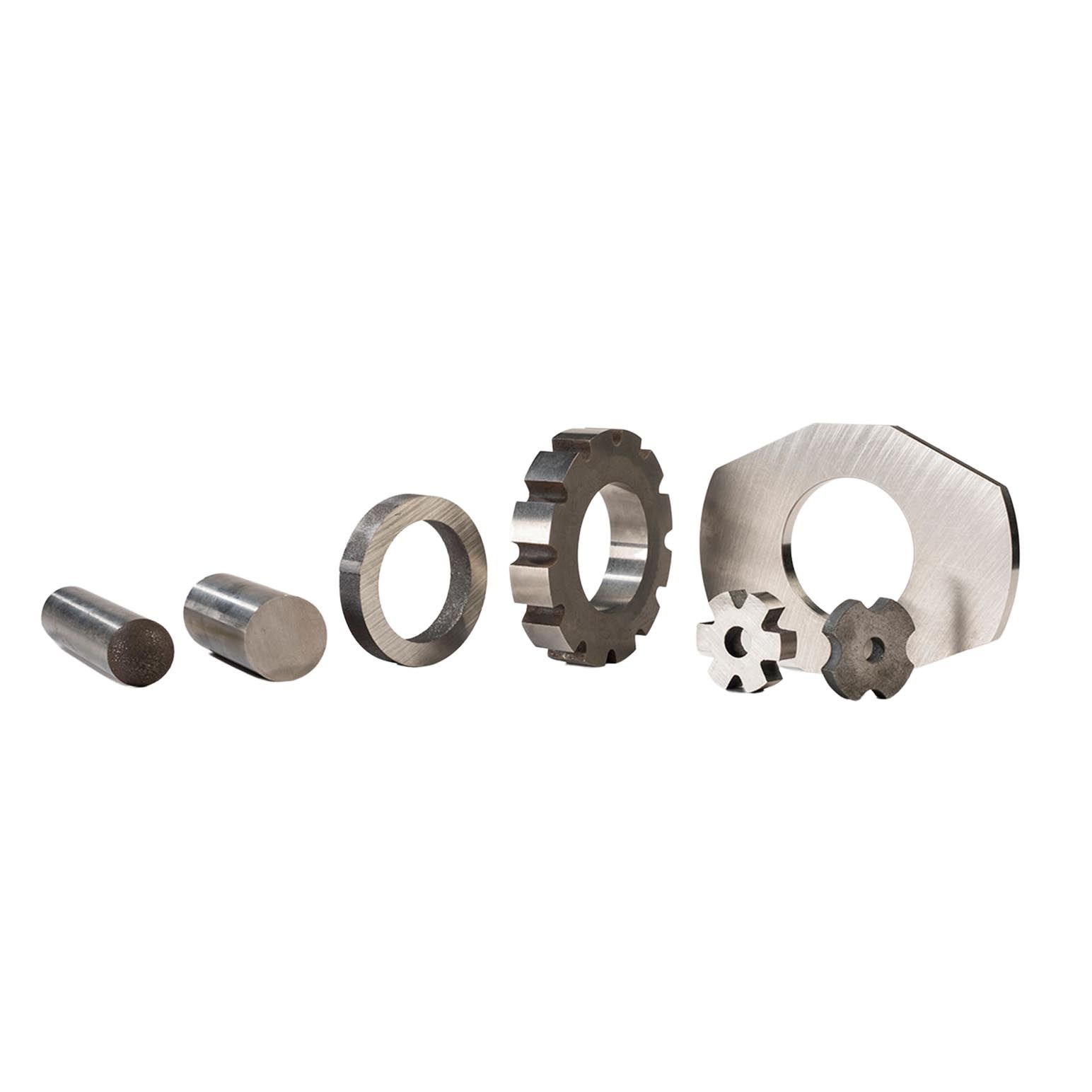
What are AlNiCo Magnets?
Alnico magnets are a remarkable class of permanent magnets primarily composed of aluminum (Al), nickel (Ni), and cobalt (Co), from which their name is derived. These core elements are often supplemented with other metals such as copper (Cu), iron (Fe), and titanium (Ti) to fine-tune their magnetic and mechanical properties. The specific alloying elements and their proportions dictate the magnet’s ultimate performance, allowing for a wide range of applications.
A key distinction among Alnico magnets lies in their magnetic orientation: they are available in either isotropic or anisotropic versions. Isotropic Alnico magnets possess uniform magnetic properties in all directions, meaning they can be magnetized along any axis after manufacture. This offers flexibility in design and application. In contrast, anisotropic Alnico magnets are characterized by a preferred direction of magnetization. This preferential alignment is achieved during their manufacturing process, typically by cooling the alloy in the presence of a strong magnetic field, which aligns the crystalline grains. This controlled directional solidification results in significantly higher magnetic performance, particularly in terms of remanence and energy product, along the predefined axis compared to their isotropic counterparts.
Key Properties and Characteristics
Compositional Nuances and Their Impact
The unique blend of metals in Alnico alloys provides them with exceptional characteristics. Aluminum contributes to the material’s hardness and helps form intermetallic compounds critical for magnetic properties. Nickel enhances ductility and corrosion resistance, while cobalt significantly increases the magnetic coercivity and remanence, especially at elevated temperatures. Copper improves the magnetic properties and workability, and iron forms the bulk of the ferromagnetic material. Titanium, when present, further refines the grain structure, leading to even higher coercivity values. This careful balance of elements allows Alnico magnets to maintain their magnetic integrity under conditions where other magnet types might fail.
Isotropic vs. Anisotropic: A Closer Look
The manufacturing process is crucial in determining an Alnico magnet’s final properties. Isotropic Alnico is typically produced by casting or sintering without a subsequent magnetic field treatment during solidification. This results in a microstructure where magnetic domains are randomly oriented, allowing for magnetization in any direction but with a lower overall magnetic strength. Anisotropic Alnico, on the other hand, undergoes a critical heat treatment in a magnetic field. This process, known as thermomagnetic treatment, aligns the elongated iron-cobalt precipitates within the aluminum-nickel matrix, creating preferred paths for magnetic flux. This directional alignment dramatically enhances the magnet’s ability to retain magnetism (remanence) and resist demagnetization (coercivity) along the defined axis, making them ideal for applications requiring stronger, more stable fields.
Performance in Extreme Conditions
Alnico magnets stand out due to their exceptional stability across a wide range of temperatures. Their ability to operate effectively at temperatures up to 540°C (1000°F) makes them indispensable in high-temperature environments where rare-earth magnets would rapidly lose their magnetic properties. This high-temperature resistance is a direct result of their metallurgical composition and microstructure. Furthermore, Alnico magnets possess high physical strength, making them robust and resistant to cracking or breaking, which contributes to their longevity and reliability in demanding industrial applications. Their inherent electrical conductivity also makes them suitable for applications requiring electrical interaction with the magnetic field.
Applications and Their Unique Advantages
Despite the emergence of stronger rare-earth magnets like Neodymium, Alnico magnets continue to play a critical role in various specialized applications where their unique combination of properties is indispensable. Their excellent temperature stability, high magnetic strength, and ease of magnetization/demagnetization make them uniquely suited for specific niches.
Why AlNiCo Endures: Specific Use Cases
Alnico magnets are widely utilized in the manufacture of precision sensors, such as speed sensors and proximity switches, where their stable magnetic output over varying temperatures ensures consistent performance. They are also crucial components in various types of relays, medical devices, and high-temperature equipment, including aerospace components and industrial furnaces, where their ability to withstand extreme heat is paramount. A particularly critical application for Alnico magnets is in electro-permanent magnetic tables and lifting equipment. In these systems, Alnico’s unique characteristic of having a high magnetic strength combined with a relatively low resistance to controlled demagnetization and re-magnetization is leveraged. By winding coils of wire around Alnico magnets, they can be easily magnetized or demagnetized through the controlled flow of electric current. This precise control allows for rapid engagement and disengagement of magnetic forces. For instance, lifting and fixing equipment capable of handling 100 tons per square meter can be opened and closed in as little as 0.2 seconds, demonstrating the remarkable efficiency and responsiveness enabled by Alnico technology in heavy-duty industrial operations.
Advantages;
- High corrosion resistance: Alnico magnets exhibit excellent resistance to oxidation and many corrosive agents, ensuring long-term reliability in harsh environments without needing protective coatings.
- High physical strength (does not crack or break easily): Their inherent robustness makes them durable and suitable for applications subjected to mechanical stress or vibration.
- High temperature resistance (up to 540°C): This is a primary advantage, allowing them to maintain magnetic performance in extreme heat where other magnet types would fail.
- Electrical conductivity: Their metallic nature allows for electrical current to flow through them, which is vital in applications like electro-permanent magnets where controlled magnetization and demagnetization are required.
Disadvantages;
- They can be easily demagnetized (magnets need to be stored with a shield to allow the magnetic field to continue to flow around the magnet): Compared to rare-earth magnets, Alnico has a lower coercivity, making it more susceptible to external demagnetizing fields. To prevent irreversible demagnetization during storage or when not in use, Alnico magnets should be stored with “keeper bars” or within a closed magnetic circuit. These shields provide a low-reluctance path for the magnetic flux, effectively “closing” the magnetic loop and preserving the magnet’s field strength.
- It has weaker magnetic attraction force than new generation Neodymium magnets: While Alnico offers excellent temperature stability, its maximum energy product (a measure of magnetic strength) is generally lower than that of Neodymium magnets. This means for applications requiring the absolute strongest magnetic pull at room temperature, Neodymium might be preferred. However, Alnico’s advantages in high temperature and controlled demagnetization often outweigh this difference in specific use cases.
The Enduring Value of AlNiCo Magnets
In conclusion, Alnico magnets, with their unique blend of high magnetic strength, exceptional temperature stability, robust physical properties, and electrical conductivity, continue to hold a vital place in modern technology. While newer magnet types excel in sheer magnetic power at room temperature, Alnico’s ability to perform reliably in extreme heat and its suitability for electro-permanent applications ensure its continued relevance. Their distinctive characteristics make them the ideal choice for demanding industrial, aerospace, and sensor applications where performance under challenging conditions is paramount.
We offer you the widest variety of AlNiCo magnets.